
In this article
- Context switching: statistics
- Context switching: why is it exploding?
- Context switching: cost
- Context switching: solutions
- Conclusion
- FAQ
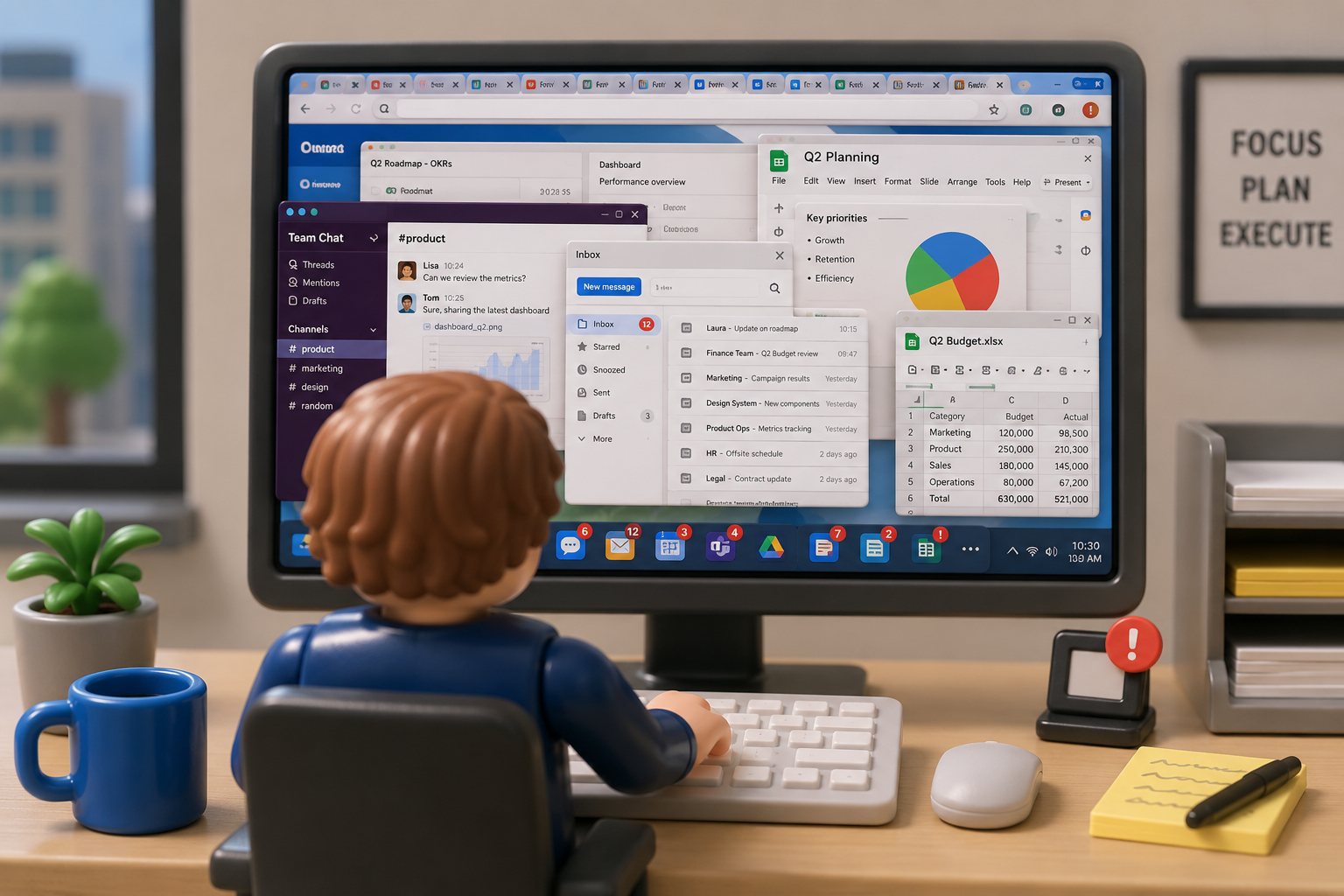
Look at your colleague's screen. 100+ browser tabs open. Slack blinking on one monitor, Teams on the other, email somewhere in between. Sound familiar?
We didn't get here overnight. For most of history, work meant one task at a time, full focus, both hands (and sometimes legs) on it. Then computers arrived, Windows 95 made it possible to run everything at once, and we celebrated: multitasking! Progress!
Thirty years later, the verdict is in: the human brain is simply not wired for it. Every jump between apps, tabs, and conversations triggers what researchers call “context switching” and context switching is poison for your focus. Some studies suggest it can take over 20 minutes to fully recover your concentration after a single interruption.
And here's the part most productivity advice misses: the problem isn't your discipline, and closing tabs won't fix it. The problem is that your work itself is fragmented, the same project, the same conversation, scattered across tools that don't talk to each other.
In this article, we'll look at why context switching keeps rising, what it really costs you, and how to actually fight it, not with willpower, but by fixing the fragmentation at the source.
Context switching: statistics
The numbers behind context switching are staggering. A 2022 study published in Harvard Business Review, which tracked 137 employees across three Fortune 500 companies, found that workers toggle between apps and websites roughly 1200 times per day, spending just under four hours a week simply reorienting themselves after each switch!
That's about 9% of their work time, or five full working weeks per year, lost to switching alone.
And the cost of each switch goes far beyond the click itself: research by Gloria Mark at the University of California, Irvine shows that after an interruption, it takes an average of 23 minutes to fully refocus on the original task.
The tools themselves keep multiplying, according to Asana's Anatomy of Work Index, employees juggle around 10 different apps daily, and a quarter of heavy app users report missing important messages and actions because of the constant switching.
Context switching: why is it exploding?
How did we get here? Several factors explain the rise:
-
Devices
The first one, as mentioned above, is the very device we work on: the computer. Processors, operating systems, multiple screens, polished and fast interfaces, everything is engineered for high-performance multitasking. Add a phone on top, sometimes a tablet or other "smart" devices, and we are permanently over-exposed. -
Notifications
The second one we all know too well. Notifications are numerous, often intrusive, but above all they exploit our curious minds: who can resist checking what's behind that little red dot? And it's no longer just communication tools, nearly every app now sends them, competing for your attention, pushing you to act or decide, on matters both minor and major. -
The productivity quest
Always more. The modern world has the infinite pursuit of "more" written into its DNA: more work, more efficiency, more output. Whatever one thinks of that model, one thing is clear, it pushes most of us to cram more things into a single day, which often means more multitasking. -
Too many tools that don't talk to each other.
And here lies the deepest issue: most tools are simply not connected. Users end up copy-pasting data from one app to another just to build a report. iPaaS platforms like Zapier cover many of these gaps but not all.
Look at communication tools: Slack, Teams, WhatsApp, Google Chat, Discord, none of them are natively interoperable. Even though the EU's Digital Markets (DMA) Act forced (in article 7) Meta to open up WhatsApp and Messenger to interoperability, very few players have actually taken advantage of it.
The result of all this? Most of us now sit surrounded by apps, tabs, and scattered information all quietly devouring our attention.
Context switching: cost
-
Human Cost
Some of us wear context switching as a badge of honor, a sign of busyness, even proof of importance within the organization. But what it actually produces is the same for everyone (assuming you're human like me :)): loss of focus, cognitive fatigue, reduced working memory and if left unchecked, rising stress, lower motivation, and eventually burnout.
Why? Because every switch forces the brain into a state of constant re-orientation, which is mentally exhausting. And unfortunately, there's not much we can fix on the human side (unless you're volunteering for a brain chip :)). The real solutions lie in how we organize work, and in the tools we use. -
Productivity Cost
On the business side, context switching also comes with a cost, one that can be quantified:- 45% of employees say switching between work apps makes them less productive, and nearly one in two report making mistakes because they can't keep track of information scattered across tools (VentureBeat, covering the Qatalog/Cornell Workgeist Report)
- Each additional task juggled simultaneously costs about 20% of your productivity, according to computer scientist Gerald Weinberg (ActivTrak)
- Frequent task switching can consume up to 40% of a person's productive time (Atlassian, based on APA-published research)
- Employees face a ping from meetings, emails, or chats every two minutes during core work hours, 275 interruptions per day (Microsoft Work Trend Index 2025)
Context switching: solutions
The good news? There are plenty of solutions, covering many angles:
-
Define deep work hours
Set yourself completely offline, or use a dedicated do-not-disturb feature such as focus mode in Slack. If you've ever worked on a train with no internet connection, you know it's probably the most efficient way to work: zero distractions! These deep work hours should be shared with your teammates and ideally aligned across the whole department. -
Close your communication tools
When starting a task that requires sustained attention, don't hesitate to actually close the tools that can interrupt you, and there are plenty: phone, Slack, Teams, email... -
Use focus music
You'd be surprised by the power of music designed for concentration. Every music and video streaming platform offers dedicated focus playlists (and you'll even get to pick your side in the 440Hz vs 432Hz debate ;) ) -
Connect your tools
One of the main causes of context switching is tools that aren't linked together. Major software vendors have recognized this problem and built solutions to bridge them: iPaaS platforms (Make, Zapier), but also Slack and Teams themselves, with a growing number of apps (see this article).
Zooming in on communication tools specifically: conv.ly's mission is precisely to embed your secondary platform into your primary one. In other words, you can manage your Teams messages from Slack and keep Teams closed. That's one less app to keep open and check, and at the end of the day, it makes a real difference.
Conclusion
You've got it: context switching is one of the poisons of modern work. Over time, we've multiplied devices, screens, tools, and notifications but our brain hasn't changed, and it can still only handle one task at a time. The impact on both mental health and productivity is significant, so it's a fight worth picking. Fortunately, solutions exist: defining deep work hours, muting notifications, connecting your tools together...
We wish you a great focus time, one task at a time!